 Because nothing destroys a long-term friendship faster than aggressively undercutting the price of a hamburger.
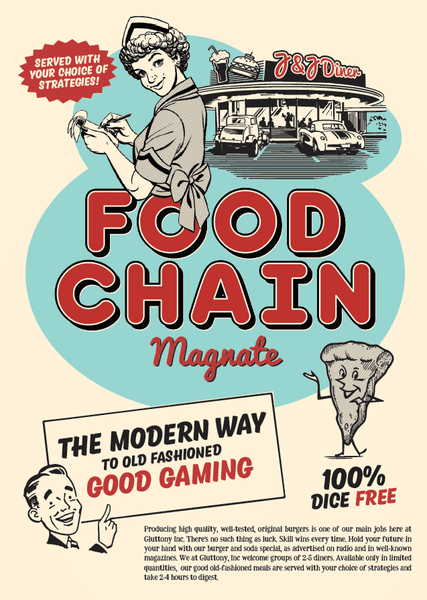
Let’s get something perfectly straight. Food Chain Magnate does not look like a modern board game. It looks like a beige graphical user interface from a mid-1990s accounting software package. The board is completely bland. The cards look like they were designed on Microsoft Paint. It costs an absolute fortune to buy, and the publisher vehemently refuses to upgrade the visuals. But the sheer, unadulterated ruthlessness packed inside this violently capitalistic box is so completely flawless that you will entirely forget you are staring at ugly cardboard.
The premise is simple: you are managing a 1950s fast food empire. You must hire a corporate structure. You hire an errand boy, who eventually gets promoted to a purchasing manager, who eventually gets promoted to an executive vice president. You build a massive, sprawling corporate pyramid of employees simply to source a single bottle of lemonade. But the genius—and the sheer, terrifying cruelty—of the game lies in its demand and marketing mechanics. Citizens on the map will not buy food unless they actively want it. How do you make them want it? You build a massive billboard aggressively advertising pizza directly in front of their house!
They suddenly want pizza! But wait! The absolute genius of the game kicks in. Just because you built the billboard and generated the demand for pizza does not legally mean they have to buy the pizza from you. The player sitting opposite you—the absolute scoundrel—can simply hire a Discount Manager, lower their pizza prices by $1, and mathematically steal every single customer you just spent two hours advertising to. You get precisely nothing. You go completely bankrupt. The bank closes, and you lose the entire game simply because your burgers were twenty cents too expensive. It is a masterpiece of aggressive, cutthroat economics where a single pricing mistake fundamentally eradicates your entire corporate structure.
Family Session vs. Hardcore Gamers
Could you bring this out with the family? If your idea of family bonding is watching your father violently undercut your lemonade stand into abject poverty before firing all of his employees to avoid paying their wages, then yes. Otherwise, absolutely not. The game is phenomenally brutal. There is no catch-up mechanic. If you fall behind in round three, you will spend the next three hours watching everyone else get rich while you starve in the gutter. This is explicitly designed for a highly combative hardcore gaming group who don't mind shouting at each other over the price of a fictional soda.
Pros:
- A completely unforgiving, razor-sharp economic simulator with zero luck involved.
- The marketing versus pricing mechanic creates incredible, highly aggressive table tension.
- The corporate org-chart building is incredibly satisfying and logically brilliant.
Cons:
- A single terrible turn in the early game completely knocks you out of contention forever.
- The component quality is actively hostile to your eyes and aggressively beige.
- The box costs an absolute premium despite looking like a high school art project.
Final Verdict: Convince a friend to buy it. It is an absolute masterpiece of cutthroat capitalist optimization. But let them absorb the massive financial cost of buying an incredibly ugly, incredibly brilliant box that will make you hate each other fiercely over the price of a virtual hamburger.