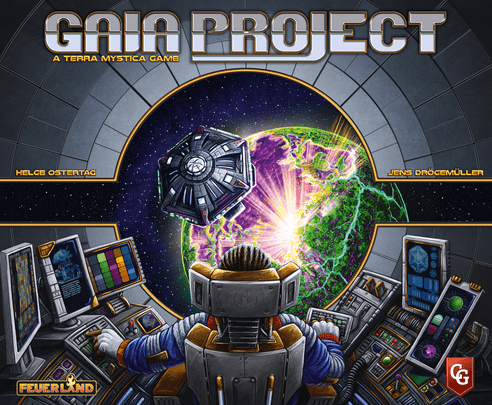
 Terra Mystica in space, featuring aggressive plastic planets and a tech tree that practically requires an astrophysics degree.
Right. If you read the review for Terra Mystica and thought, "Yes, that looks like an absolutely brilliant, brain-burning puzzle, but what if instead of brown fantasy dirt, we did exactly the same thing but with terrifying alien species aggressively terraforming planets across a modular galactic void?" Congratulations. You have successfully identified Gaia Project. This is Terra Mystica 2.0. It took the flawlessly engineered mathematical core of its predecessor, strapped literal rockets to it, and jettisoned it into the stratosphere.
Instead of a static, unchangeable board, the galaxy is composed of modular hexagonal sectors. This completely fixes the absolute worst aspect of Terra Mystica, which was knowing exactly where everyone was going to build before the game even started. Now, you are dynamically expanding your interstellar empire across shifting solar systems. You play as one of 14 entirely asymmetrical alien factions—perhaps the Geodens, who literally eat planetary data for breakfast, or the terrifying Nevlas, who maliciously bend the rules of the entire power mechanic. You are still aggressively terraforming planets to match your specific environmental requirements before you can build a physical plastic mine on them.
But the absolute absolute crowning achievement of Gaia Project is the new Science track. My god, the Science track. In the original game, climbing the cult tracks felt like a completely disconnected, boring mini-game. Here, investing in technology fundamentally alters how your entire empire functions. Researching navigation allows your ships to jump further across the void. Researching terraforming makes it inherently cheaper to physically boil the atmosphere of an ice planet! Watching an opponent casually leap across three empty hexes to aggressively colonize a 'Gaia' planet right out from under your nose simply because they invested heavily in quantum navigation will make you want to throw the entire modular board out the nearest window.
Family Session vs. Hardcore Gamers
Is this a family game? I will put this as simply as possible: If you bring this out at a family gathering, you will be legally disowned. The cognitive overload of managing six different dynamic technology tracks while simultaneously trying to optimize a passive power-bowl charging system is actively terrifying. This is the absolute apex of the heavy Euro-game genre. It is explicitly designed for hardcore strategy veterans who relish the opportunity to quietly stare at a map of plastic satellites for four hours in deep, mathematically taxing concentration.
Pros:
- The modular board completely revolutionizes replayability compared to Terra Mystica.
- The integrated technology tracks provide unbelievably satisfying, game-altering upgrades.
- Zero luck. Absolute deterministic warfare where the smartest player mathematically wins.
Cons:
- The sheer volume of incredibly complex rules will absolutely break casual players.
- The plastic miniatures look uncomfortably like brightly coloured 1980s candy.
- Analysis paralysis is effectively guaranteed during the final two scoring rounds.
Final Verdict: Buy it yourself. If you have the mental stamina, it completely obsoletes its predecessor by fixing every minor flaw. It is a staggering achievement in heavy strategy gaming that will completely consume your gaming group's attention for months on end.