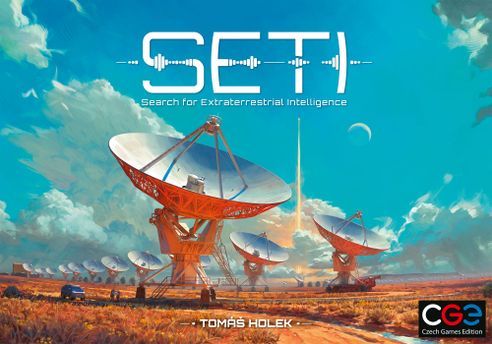
 Because scanning deep cosmic static for three hours is actually more exciting than most Euro-games.
Right. Listen very carefully. In 2024, the heavy Euro-game market was absolutely swamped with trading games, castle-building games, and vague agricultural simulations. And then this colossal, incredibly dense space simulator dropped out of absolutely nowhere and actively dominated the global conversation. SETI is not just a game; it is an agonizingly tense, beautifully researched attempt to physically locate intelligent life in the universe using an enormous rotating solar system board that will fundamentally break your brain if you look at it for too long.
You play as a rival space agency trying to successfully analyze distant galaxies, launch intricate probe missions across the solar system, and aggressively manage an array of terrestrial radio telescopes. But the absolute mechanical genius of the game lies in its central rotating board. The planets naturally physically orbit the sun as rounds progress. If you desperately need to send a lander to Mars, you cannot just lazily launch it whenever you feel like it! You have to intimately plan your orbital mechanics three rounds in advance so that Mars is actually geographically physically close to Earth when your probe leaves the atmosphere. If you mistime it, your probe practically drifts uselessly into the vast emptiness of the outer solar system while your opponent casually lands on a passing asteroid and claims a massive discovery bonus.
And the cards! The game features over 200 entirely unique, scientifically accurate technology and mission cards. You aren't just 'gaining wood and stone.' You are utilizing advanced spectroscopy, deploying deep space listening arrays, and analyzing incredibly complex cosmic background radiation data. Building a cascading engine of passive scientific data collection feels stunningly rewarding, but the constant race to analyze the 'alien signal' before your heavily funded opponents creates a remarkably tight, claustrophobic tension despite the literal astronomical scale of the board.
Family Session vs. Hardcore Gamers
Could you physically assemble this for a casual Sunday family session? Absolutely not. Even attempting to explain the multi-layered action point system or the planetary orbital mechanics to someone who isn’t already deeply invested in heavy board gaming will immediately result in them asking to play Scrabble instead. The cognitive load required to balance launching probes alongside deep-space telescope scanning is immensely punishing. This is an Apex Predator Euro-game. It is specifically designed for your hardcore analytical friends who want to lock themselves in a room for three sweaty hours and pretend they work for the European Space Agency.
Pros:
- The rotating planetary orbital mechanic is one of the smartest board designs of the last five years.
- Thematically, it feels flawlessly accurate; you really feel like you are heavily managing a space program.
- Card combo-chaining provides an incredible, deep engine-building satisfaction loop.
Cons:
- The sheer volume of iconography on the 200+ cards is initially overwhelmingly intimidating.
- Setup and tear down is a colossal chore involving dozens of heavily segmented plastic baggies.
- A single miscalculation regarding planetary alignment will mathematically ruin your entire probe mission.
Final Verdict: Buy it yourself. It is arguably the absolute heaviest, smartest, and most mechanically satisfying release of the modern calendar year. If you have any interest whatsoever in astronomy and deeply complex interconnected resource tracking, SETI is an absolutely mandatory purchase.