 Turning a cold, dead rock into a slightly less cold, slightly damp rock.
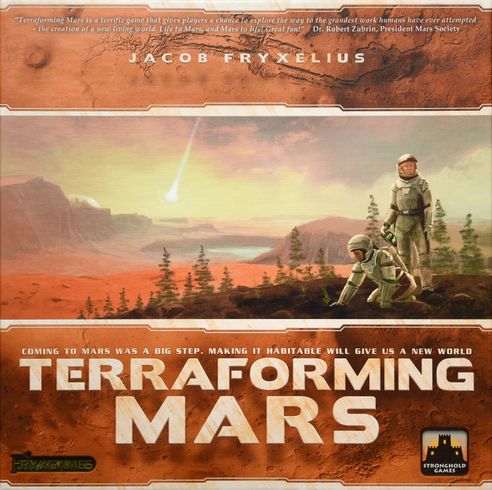
Terraforming Mars. The undisputed heavyweight champion of the engine-building world. It is a game that politely masks a viciously aggressive corporate takeover under the guise of 'improving humanity's future'. You represent a giant, faceless mega-corporation, and you are competing to make the Red Planet habitable. How do you do this? By throwing enormous, slightly precarious cardboard asteroids at it, planting some remarkably resilient grass, and jacking up the global temperature until your opponents sweat through their shirts. It sounds majestic, but in reality, it involves wrestling with arguably the worst player boards ever designed by a modern game publisher.
Let’s get the elephant out of the room right now. The component quality in the original box is atrocious. The artwork looks like it was cobbled together using stock images from a 1990s CD-ROM encyclopedia. The player boards are flat, slippery pieces of thin cardboard designed explicitly to ruin your entire evening. If someone sneezes across the table, your entire corporate economy—thirty meticulously tracked metallic cubes—will instantly slide off their designated tracks, turning your incredibly tuned engine into a chaotic, unreadable mess. It is infuriating. You will immediately need to spend extra money on third-party dual-layered boards just to protect your sanity.
But my god, the gameplay. Once you look past the components, the internal engine of this game is completely spectacular. You buy cards, you play cards, and you slowly, agonizingly ramp up your production until you are churning out massive amounts of titanium, steel, and heat. The sheer satisfaction of finally saving up enough mega-credits to slam down a giant space mirror card, instantly boosting the planet’s temperature and stealing a crucial ocean tile location right out from under a corporate rival, is intoxicating. It’s an incredibly tight economic puzzle where every single credit matters, and the card synergies you can discover are practically endless.
Family Session vs. Hardcore Gamers
Is this suitable for a casual family gathering? If your family enjoys spending two hours staring silently at their own spreadsheets, mentally calculating the conversion rate of thermal energy to greenery tiles, then it's a roaring success. The complete lack of direct confrontation (asteroids aside) means feelings rarely get hurt. However, the sheer length and mathematical density make it far more suited to a group of hardcore, spreadsheet-loving gamers who appreciate a deep, rewarding, long-term economic grind.
Pros:
- The engine-building mechanics are flawlessly tuned and incredibly rewarding.
- With over 200 unique project cards, replayability is genuinely endless.
- Watching the map slowly turn from red to green and blue is visually brilliant.
Cons:
- The base component quality is dangerously bordering on offensive.
- You essentially need an Excel degree to track resource production efficiently.
- A sneeze can literally destroy four hours of economic planning.
Final Verdict: Buy it yourself. Despite looking like a high school science project, the structural gameplay is an absolute masterpiece of modern design. Just make absolutely sure you purchase upgraded player boards along with it, or you will eventually throw the entire box into the street.