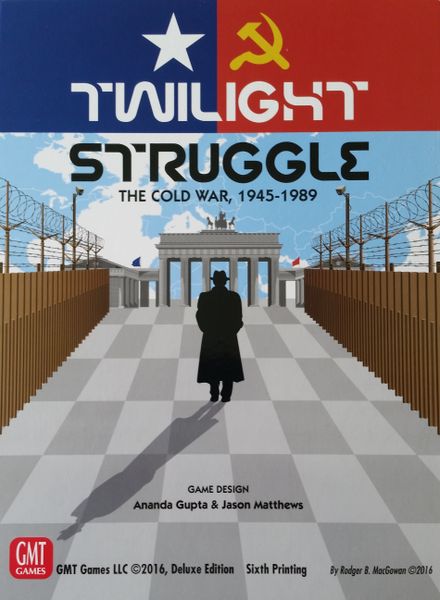
 Three hours of deeply paranoid, sweat-inducing political tension masquerading as an area control game.
Look at the board. It is an incredibly dry, muted map of the entire 1945–1989 globe covered in tiny little cardboard numbers. The theme is the Cold War. There are absolutely no plastic miniatures. There are no dice-chucking explosive battles. You are simply placing numbers in countries. By all modern, sensible metrics of board game design, this should be the most monumentally boring historical simulation ever put to print. And yet, Twilight Struggle held the undisputed #1 spot on BoardGameGeek for half a decade because it is, without a doubt, the single most stressful two-player psychological battle ever designed by human hands.
You play as either the USA or the USSR. The mechanics are elegantly, infuriatingly simple. You have a hand of cards, and each card represents a real historical event. You can play a card for its 'Operation Points' to quietly spread your political influence into France, or you can play it to trigger the historical event itself—like the creation of NATO or the Cuban Missile Crisis. But the sheer, devastating genius of the game lies in a single rule: If you play a card that belongs to your opponent, their event triggers automatically.
You will literally draw a hand of cards composed entirely of terrible, devastating Soviet events. You are the USA. You are holding the physical manifestation of the Korean War, Fidel Castro, and the Suez Crisis. You physically cannot discard them. You must play them! Every single turn becomes an agonizing damage-mitigation exercise where you desperately try to trigger Soviet victories at the exact moment they do the least amount of global damage. You are constantly bluffing, sweating, and trying to convince the person sitting solidly across from you that you are firmly in control of Europe, when in reality, you are one terrible card draw away from a massive DEFCON 1 nuclear apocalypse.
Family Session vs. Hardcore Gamers
Could you bring this out with the family? Honestly, absolutely not. Unless your significant other explicitly possesses a degree in 20th-century geopolitical history and enjoys intensely adversarial conflict, it is a catastrophic idea. It is three continuous hours of a zero-sum tug-of-war. Every time you successfully flip Italy to your side, you are physically stripping those points directly from your opponent. It is inherently mean. Keep this securely locked away for the single, deeply competitive history-buff in your gaming group who wants a heavy, highly thematic Sunday afternoon duel.
Pros:
- The tension engine is unparalleled; every single card play feels incredibly dangerous.
- The historical theme is integrated so flawlessly you actually feel like a tired politician.
- Absolutely phenomenal, wildly shifting tug-of-war momentum swings across regions.
Cons:
- You must intimately memorize the entire deck of cards to play competitively.
- The game length is robust; a tight match will easily exceed three grueling hours.
- Early dice rolls regarding the Space Race or nuclear coups can occasionally feel too lucky.
Final Verdict: Buy it yourself. It defined the two-player card-driven wargame genre. Playing it is a rite of passage. It is stressful, it is deeply punishing, and the profound relief you will feel when the Berlin Wall finally falls in your favor is completely unmatched.